 Dibz
What does a real estate lawyer do for a buyer in Ontario? (2026)
Your lawyer checks title, handles the money, pays land transfer tax and registers the home in your name. What they do, the rules they follow and what you pay.
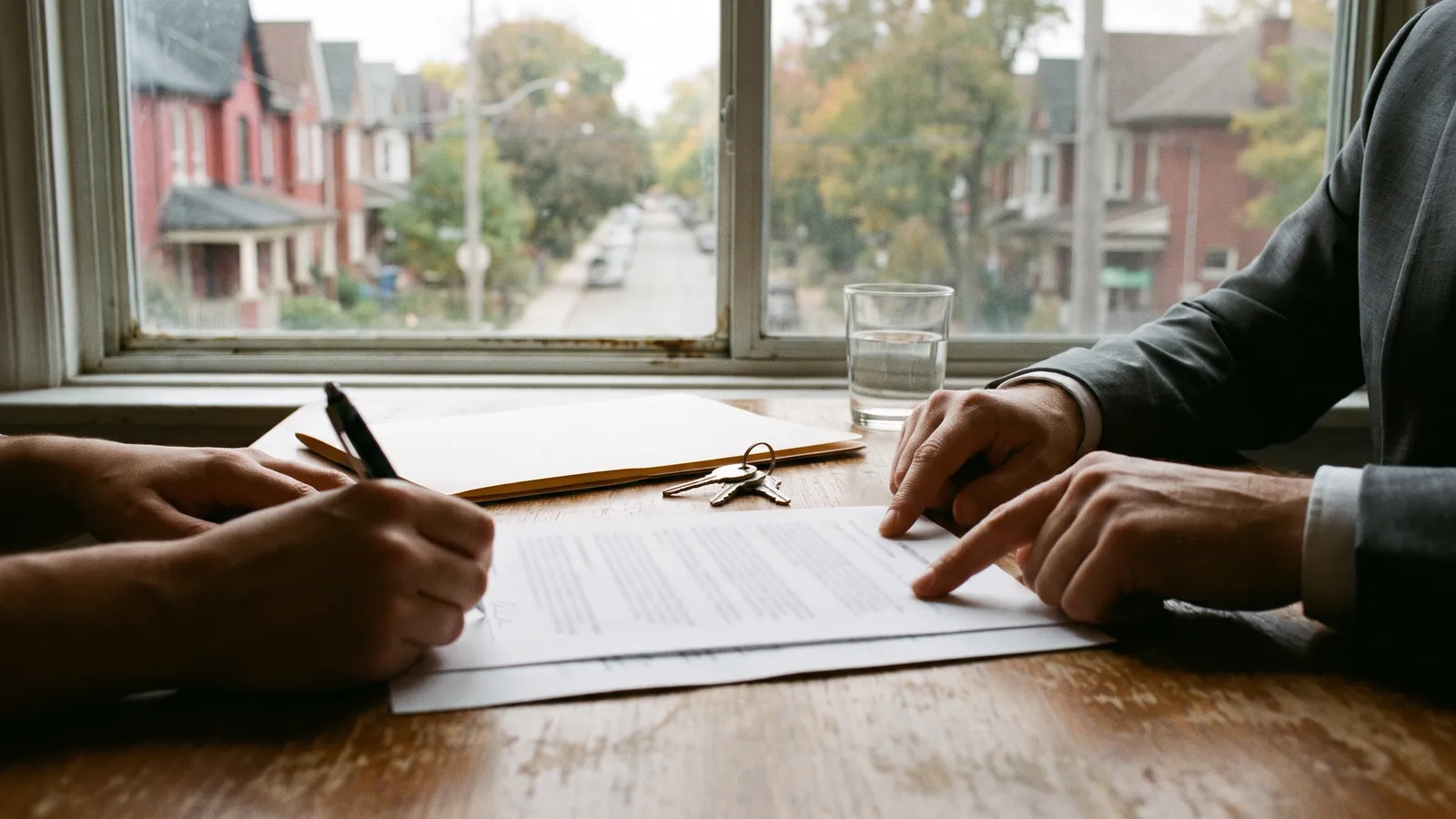
When you buy a home in Ontario, your real estate lawyer is the person who turns a signed agreement into a home registered in your name. They review the deal, search the title, take in your down payment and the lender's mortgage money, pay land transfer tax and register the transfer and your mortgage on closing day. What you pay is their fee, plus HST, plus disbursements, which include the province's registration fee of $86.42 for each document registered electronically.
Below: what the lawyer does at each stage, the Law Society rules that protect you, what makes up the bill, and how to find one.
- Before or after you signOffer stage
Reviews the agreement of purchase and sale if you ask, and explains conditions, the closing date and what you're agreeing to.
- Once the deal is firmWeeks before closing
Searches the title and the parcel register, checks for liens and writs, and reviews any status certificate for a condo.
- Mortgage and insuranceClosing weeks
Takes instructions from your lender, explains your title insurance options and prepares the statement of adjustments.
- Funds and signingDays before closing
Collects the balance of your down payment and closing costs, and has you sign the transfer, mortgage and tax statements.
- Closing dayThe agreed date
Registers the transfer and mortgage, pays land transfer tax, sends the money to the seller's side and releases the keys.
- After closingWithin 60 days
Sends your lender its final report on the registered mortgage, unless the lender sets another deadline.
General order of steps. Your lawyer sets the exact work and timing for your purchase.
Before you sign: the agreement
A lawyer is most useful before you're bound. The agreement of purchase and sale sets the price, the deposit, the closing date, the conditions and what's included. Once it's firm, changing any of it takes the seller's agreement. Many buyers sign first and call a lawyer after; if you can, line one up before you make offers so they can look over a draft, or at least answer questions about conditions such as financing or an inspection, and about firm vs conditional offers.
Once the deal is firm: checking the title
"Title" is legal ownership. Your lawyer's main job is making sure the seller can give you clean title and that nothing registered against the property will follow you after closing. That usually means:
- Searching the parcel register, the land registry record for the property, for the current owner, mortgages, liens, easements and other registrations.
- Searching for writs (court judgments) against the seller's name.
- Asking for the seller's mortgages to be paid off and discharged as part of closing.
- For a condo, reviewing the status certificate for the building's finances, any special assessments and the rules you'll live under.
- Raising problems with the seller's lawyer before closing, in writing, so they can be fixed.
Title insurance: your lawyer must explain your options
Most buyers end up with title insurance, and the Law Society of Ontario sets clear rules for how lawyers deal with it. Under its Rules of Professional Conduct, your lawyer must:
- assess all reasonable ways to assure title, and tell you that title insurance is not mandatory and isn't the only way to protect you (rule 3.2-9.4);
- take no payment from a title insurer, agent or intermediary for recommending a policy (rule 3.2-9.5), and tell you that no commission or fee is being paid to them for it (rule 3.2-9.6).
The Law Society's commentary adds that title insurance is not a substitute for a lawyer's services in a real estate deal.
The mortgage: one lawyer, two clients
Your lender also needs a lawyer to register its mortgage, and it's common for your lawyer to act for both of you. The Law Society's rules generally don't allow a lawyer to act for both lender and borrower, but they make exceptions, including when the lender is a bank, trust company, insurance company, credit union or another listed institutional lender (rules 3.4-12 to 3.4-14).
When the same lawyer acts for you and your lender, they must tell both of you, in writing and before the mortgage money is advanced, all material information about the deal (rule 3.4-15). The Law Society's example is a "flip", where a property is resold within a short time for a much higher price. Your lawyer must also send your lender a final report on the mortgage within 60 days of registration, unless the lender sets another deadline (rule 3.2-9.8).
Your lawyer can't also act for the seller
An individual lawyer generally can't act for both the buyer and the seller in the transfer of a property (rule 3.4-16.7). The exceptions are narrow: related persons as defined in the Income Tax Act, a remote area with no other lawyer reasonably available, or a case where land registration law lets the lawyer sign for both sides (rule 3.4-16.9). A law firm with two or more lawyers can act for both sides only if each side has a different lawyer in the firm and there's no conflict of interest (rule 3.4-16.8).
Closing day: money, tax and registration
In the days before closing, your lawyer prepares the statement of adjustments, which settles costs the seller prepaid or owes, such as property tax or condo fees, and tells you exactly how much to send. You'll sign the transfer, the mortgage and the land transfer tax statements.
On closing day, the lawyer registers the transfer and your mortgage electronically. Ontario's land transfer tax is payable when the transfer is registered, so your lawyer pays it then, from the funds you sent. If you're a first-time buyer, Ontario lets you claim an immediate refund of up to $4,000 at registration, through statements in the electronic land transfer tax affidavit. If you miss it, you have 18 months after registration to apply. In Toronto, the City's own municipal land transfer tax is paid too. You can estimate both with the land transfer tax calculator.
Once everything is registered and the money has moved, you get the keys. For how long all of this takes, see how long closing takes in Ontario.
What a real estate lawyer costs
There's no fixed price for a home purchase. Your bill has three parts:
- The lawyer's fee. The Law Society's rules say a lawyer can't charge a fee or disbursement unless it's fair and reasonable and has been disclosed in a timely fashion (rule 3.6-1). Its commentary says lawyers should give you, in writing and early, as much information about fees and disbursements as is reasonable, including how fees will be worked out.
- HST. Ontario's HST rate is 13%, and it applies to the lawyer's fee and to taxable disbursements.
- Disbursements. These are costs the lawyer pays on your behalf: government registration and search fees, title insurance, courier and similar charges.
The government's part is published. ServiceOntario's land registration fees, in effect since November 2, 2026, include:
Electronic registration is $72.75 statutory fee + $12.10 service fee + $1.57 HST. Your purchase may need other searches or registrations.
Source: ServiceOntario: Bulletin 2026-04, land services fee changes; Canada Revenue Agency: GST/HST rates.
A worked example. Say you buy a $900,000 resale home in Mississauga with a bank mortgage. Your lawyer registers two documents, the transfer and your mortgage, which is $172.84 in electronic registration fees. Add a copy of the parcel register ($37.10) and writ searches on the seller's name, and the government's searches and registrations come to a little over $200. The legal fee, HST, title insurance and other disbursements come on top, and those depend on the lawyer and the deal. Land transfer tax is separate and usually much larger: see closing costs in Ontario.
When you compare quotes, ask each lawyer for one written figure that lists the fee, the HST and every expected disbursement, and what would make the price change, such as a private lender, a second mortgage or a problem found in the title search.
What this means for GTA buyers
- Pick a lawyer before you make offers. If a deal comes together on an offer night, you won't have time to look for one. Your lender and the seller's side will need their name as soon as the deal is firm.
- Get a written quote. Ask for the fee, HST and disbursements in one number, and what's included.
- Claim the first-time buyer refund. Tell your lawyer if you've never owned a home, so the refund is claimed at registration.
- Send funds on time. Ask exactly when and how your lawyer needs the balance of your down payment and closing costs.
If you're still looking, you can search homes for sale on the Dibz map, estimate payments with the mortgage calculator and get help from a licensed agent through Buy with an agent. Agents can suggest lawyers, but the choice is yours.
How to find a real estate lawyer
Friends, family, your agent and your lender can all suggest names. The Law Society of Ontario also runs the Law Society Referral Service. You request a referral online at findlegalhelp.ca, and it matches you with a lawyer or paralegal who offers a free consultation of up to 30 minutes. The Law Society says you can use it for many legal issues, including buying a home, that the office should contact you within three business days, and that you can ask about fees during the consultation. The lawyer won't do legal work during that free call.
FAQ
Do I need a lawyer to buy a house in Ontario?
In practice, yes. Your lender needs its mortgage registered, the transfer has to be registered on title and land transfer tax is paid at registration. Buyers hire a lawyer to do that work and to protect their interests in the deal.
Can the same lawyer act for me and the seller?
Usually not. An individual lawyer generally can't act for both sides in a transfer of property, apart from narrow exceptions such as related persons. A firm can act for both only with a different lawyer for each side.
Can my lawyer also act for my bank?
Yes, when the lender is a bank, credit union or another institutional lender listed in the Law Society's rules. The lawyer must disclose all material information to both of you in writing before the mortgage money is advanced.
When should I hire a real estate lawyer?
Ideally before you make an offer, so they can answer questions about the agreement. At the latest, as soon as your offer is accepted, because your lender and the seller's lawyer will need their details.
Sources
- Law Society of Ontario: Rules of Professional Conduct, Chapter 3: title insurance (rules 3.2-9.4 to 3.2-9.7), reporting to the lender within 60 days (3.2-9.8), acting for lender and borrower (3.4-12 to 3.4-16), acting for transferor and transferee (3.4-16.7 to 3.4-16.9), fair and reasonable fees and written fee information (3.6-1 and commentary). Opened November 22, 2026.
- Law Society of Ontario: Law Society Referral Service: free consultation of up to 30 minutes, contact within three business days, use for buying a home. Opened November 22, 2026.
- ServiceOntario: Bulletin 2026-04, land services fee changes effective November 2, 2026: electronic registration ($86.42), parcel register copy ($37.10), writ searches ($13.30 and $17.42). Published September 14, 2026; opened November 22, 2026.
- Ontario Ministry of Finance: Land transfer tax: tax payable when the transfer is registered; Toronto's municipal land transfer tax. Opened November 22, 2026.
- Ontario Ministry of Finance: Land transfer tax refunds for first-time homebuyers: the $4,000 maximum refund, claiming at registration, the 18-month limit. Opened November 22, 2026.
- Canada Revenue Agency: GST/HST rates: Ontario's 13% HST. Opened November 22, 2026.
This article is general information, not legal, tax or financial advice. Rules change; confirm the details with your lawyer, lender or the official source.
Dibz is a home search app for the Greater Toronto Area, built on the live TRREB MLS® feed and operated by HighPoint Homes Realty, Brokerage. We write these guides from what we see in the market every day and check every rule and number against official sources, listed at the end of each article. Charts marked "Dibz analysis" are calculated from active MLS® listings on the date shown. How we research, date and correct articles: our editorial policy.
Keep reading

Statement of adjustments in Ontario (2026): who pays what
The statement of adjustments splits property tax, condo fees and other costs between you and the seller on closing day. How it works, with a worked example.

Title insurance in Ontario (2026): what it covers, do I need it?
Title insurance isn't required in Ontario, but many buyers get it. What it covers, what it leaves out, the lawyer's duties and the government's fund.

How long does closing take in Ontario? (2026)
In an Ontario resale, closing takes as long as the date you agree in your offer. What sets that date, what has to happen before it, and new-home rules.